


A startup marketing strategy is the system that decides which channels build trust, capture demand, preserve attention, and send buyer signal back into the company. For early-stage B2B startups, the useful strategy is not "post everywhere." It is a channel architecture. LinkedIn creates recognition. SEO captures active questions. AI search rewards clear answer pages. Email keeps proof warm. Outbound and CRM notes show what buyers still do not believe.
Most startup marketing strategy advice turns into a menu. Pick a niche. Set goals. Build a website. Post on social. Start SEO. Send email. Run ads later.
That is fine as a checklist. It is weak as a strategy.
The startups that are easiest to understand right now make their operating system visible. Cursor makes product speed visible. Clay makes GTM work searchable. Mercor makes a benchmark do authority work. Perplexity uses search trust to stretch into adjacent AI workflows.
The lesson is simple: the strongest startup marketing strategy makes every channel teach the next one what to say.
What this page owns
This page owns the cross-channel circuit. It does not own the full content system, the LinkedIn execution plan, the AI search diagnostic, the pre-hire publishing sequence, or the hire-vs-agency decision.
The published companion pieces already have better homes:
- For the broader asset system, read content marketing for startups.
- For founder-led LinkedIn execution, read founder-led LinkedIn content strategy.
- For resourcing, read in-house marketing vs agency.
This article is the connective layer. It answers one question: what job should each channel perform so the startup learns faster?
The startup marketing circuit
A strategy assigns a job to each channel. The job is not "get impressions" or "publish content." Those are outputs. The real jobs are trust, demand capture, answer visibility, attention preservation, and feedback.
| Channel | System job | Signal returned |
|---|---|---|
| Trust and recognition | Comments, DMs, profile views, sales-call recognition | |
| SEO | Demand capture | Queries, impressions, high-intent page visits |
| AI search | Answer-layer visibility | Citations, brand mentions, inclusion in comparison answers |
| Attention preservation | Replies, revisits, forwarded assets, ignored topics | |
| Outbound and CRM | Buyer feedback | Objections, competitor mentions, stalled-stage reasons |
Read it as a loop.
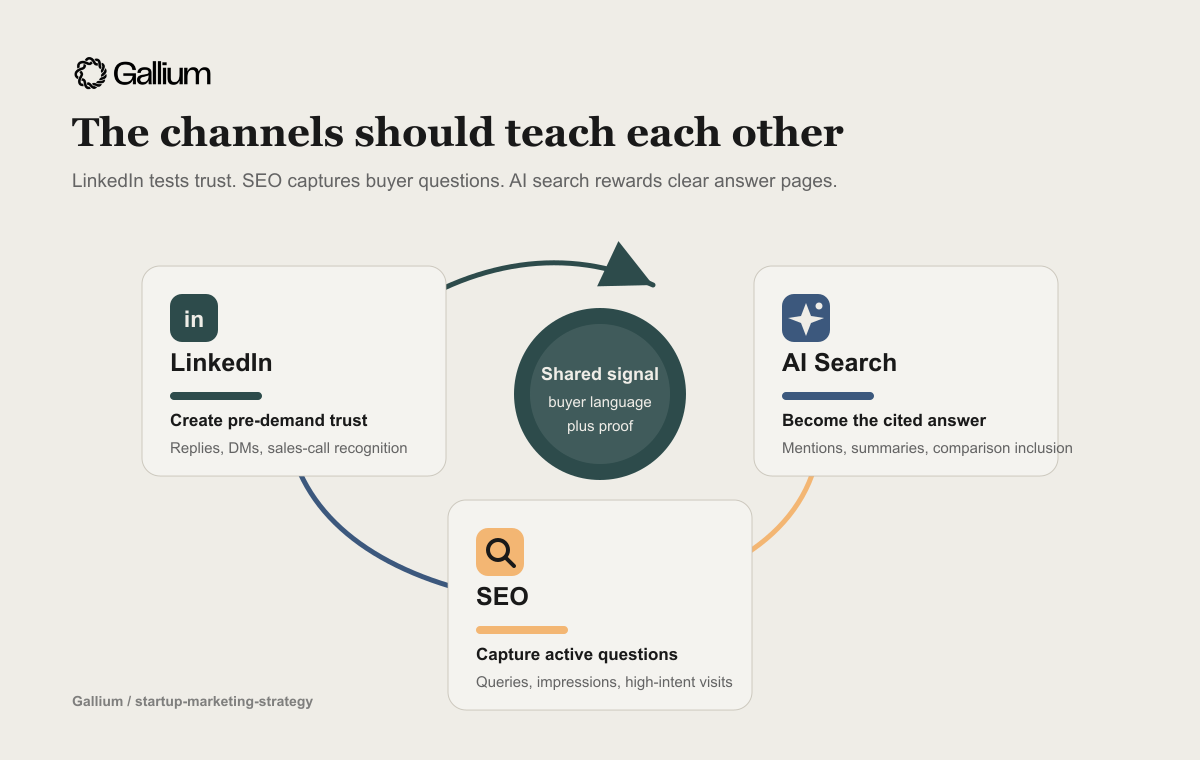
A founder posts a concrete point of view on LinkedIn. The replies reveal a buyer question that keeps coming up. That question becomes an SEO page. The page is clear enough for AI search to cite or summarize. Email brings the proof back to prospects who were not ready to buy yet. Outbound and CRM notes show which objection still blocks the deal.
That objection becomes the next post, page, FAQ, comparison section, or sales follow-up asset.
This is why "be everywhere" is the wrong starting point. A startup does not need more disconnected surfaces. It needs fewer surfaces that share memory.
What most strategy pages miss
The missing layer is signal transfer. A tactic list tells founders which channels exist. A strategy tells them what each channel should learn and where that learning goes next.
Cursor is a useful example because the public proof is visual. In a customer story about how Cursor builds, the team describes ideas moving from Slack into branches before most companies would have scheduled a meeting. That gives marketing more than a feature announcement. It creates a workflow story: product context captures the idea, an agent starts work, a human tests it, and the team decides what ships.
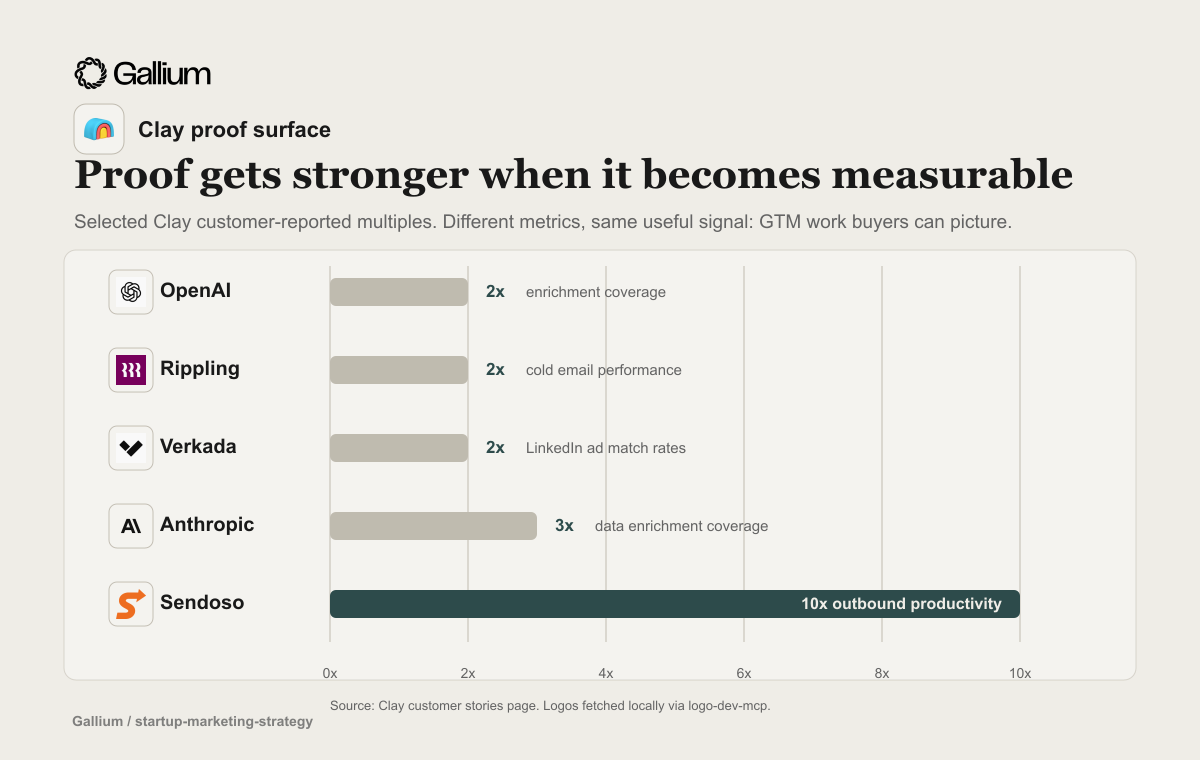
Clay turns this into category language. Its public surface makes GTM operations searchable: Claygents, Waterfall, Signals and Intent, Data Marketplace, Clay for Salesforce, and customer proof with response-rate lifts, enrichment coverage, and hours saved per rep. The marketing is not a blog calendar. It is a set of pages that turn operational language into demand capture.
Mercor shows the authority version. APEX-Agents tests whether AI agents can complete realistic consulting, banking, and legal tasks. That benchmark gives Mercor a reason to appear in conversations about professional work, agent reliability, consulting replacement, and AI evaluation. It is a source the market can reference.
Different companies. Same pattern.
The proof is already in the operating system. The startup marketing strategy decides where to route it.
A 90-day startup marketing strategy
The first 90 days should connect the channels before scaling any one channel. The goal is not maximum output. The goal is a working signal loop.
Days 1 to 30: capture proof and language. Interview the founder, review sales calls, pull buyer questions from CRM and DMs, and identify the three claims the market needs to believe. Publish one founder post, one buyer-question page, one proof asset, one sales follow-up asset, and one CRM field for repeated objections.
Days 31 to 60: connect the surfaces. If a LinkedIn post triggers useful replies, turn the language into an SEO section. If the SEO page starts showing long-tail queries, use those queries in outbound follow-up. If prospects ask the same comparison question, add the comparison section and email it to stalled deals.
Days 61 to 90: read the system. By the third month, the startup should know which LinkedIn posts create qualified conversations, which pages get buyer-language impressions, which AI answers include or omit the brand, which emails get replies, and which objections keep slowing deals.
Traffic is not the only scoreboard. Early traffic can be small while the system is working. Buyer friction is the leading indicator.
What to measure before traffic becomes meaningful
Startup marketing has to measure leading indicators before lagging indicators arrive. Waiting for perfect attribution from every channel is too slow.
Use five buckets:
| Bucket | What to watch |
|---|---|
| Trust | Founder DMs, operator comments, profile views, sales-call recognition |
| Demand capture | GSC impressions, long-tail queries, high-intent page visits |
| Answer visibility | AI search mentions, cited pages, comparison inclusion |
| Attention | Email replies, repeat visits, forwarded assets |
| Feedback | Repeated objections, buyer language, stalled-stage reasons |
The metric stack should answer one question: what did the market teach us this week?
If the answer is "nothing," the startup is measuring channel activity instead of channel learning.
How Gallium builds this system
Gallium builds startup marketing systems from founder judgment, buyer language, and proof. We do not start with a calendar. We start with the material that already exists inside the company: calls, objections, screenshots, product decisions, customer workflows, founder POV, and market confusion.
Then we decide where each piece belongs.
Some ideas should be LinkedIn posts because they need fast market reaction. Some should be SEO pages because buyers already search the question. Some should become AI search explainers because the company needs to be cited in category answers. Some should become sales follow-up assets because they answer a private objection better than a public thought-leadership post ever could.
If your startup has channels running but no shared learning system, Gallium can help diagnose where the circuit is breaking: trust, demand capture, answer visibility, attention, or feedback.
Frequently asked questions
What is the best marketing strategy for a startup?
The best marketing strategy for a startup is a channel architecture that connects trust, demand capture, answer visibility, attention, and buyer feedback. For B2B startups, that usually means founder-led LinkedIn, SEO pages for repeated buyer questions, AI search structure, email follow-up, and CRM feedback loops.
Should startups focus on SEO or LinkedIn first?
Most founder-led startups should use LinkedIn first to test language and trust, then turn repeated buyer questions into SEO pages. SEO compounds when it is fed by real customer language, founder judgment, and product proof.
How do startups measure whether marketing is working?
Start with leading indicators: qualified replies, buyer-language queries, sales-call recognition, AI search mentions, email replies, repeated objections, and content-assisted deal movement.