


TL;DR: agency, in-house, or hybrid?
In house marketing vs agency for B2B LinkedIn content is a stage decision. Pre-PMF founders should stay lightweight and learn the market. Teams with proof need the model that turns founder voice into pipeline, sales enablement, and website proof. Gallium sells these systems, so our bias is pro-specialist help — but only when there is something real to compound.
- Stay lightweight until there is proof. Without PMF signals, customer stories, repeat sales objections, or a clear ICP, founder-led posting is enough.
- Go in-house when closeness matters. Internal teams win on customer replies, launches, founder coordination, employee engagement, and community management.
- Use an agency when you need a system now. A strong B2B LinkedIn agency brings strategy, writing, editing, design, distribution judgment, and cross-account pattern recognition.
- Use hybrid when LinkedIn touches GTM. Keep access and customer context internal; use the agency to build the engine, turn raw thinking into assets, and protect cadence.
Is your company ready for B2B LinkedIn content?
Most teams ask the agency question too early. They feel the pressure to "do LinkedIn," then jump straight into hiring before asking whether the channel has enough raw material to work with.
LinkedIn compounds when there is proof. A founder post can become a sales opener, newsletter section, website paragraph, Thought Leader Ad, or SEO angle. But if the company has no customer patterns, strong beliefs, or repeat objections from sales calls, there is not much to compound.
So start with two filters:
- Proof: Do we have customer stories, product decisions, founder scars, category beliefs, or sales-call patterns worth publishing?
- Patience: Can we fund this motion for 6-12 months without turning every quiet week into a panic meeting?
If either answer is no, keep the motion founder-led and light. Post observations. Learn the language of the market. Do not buy a full content machine yet.
When in-house marketing wins for B2B LinkedIn
In-house wins when context is the scarce resource. Good B2B LinkedIn content often comes from ordinary company moments: a customer objection, a sharp sales-call phrase, a product tradeoff, a founder's private explanation that is clearer than the website.
An internal operator can catch those moments while they are still warm. They are in Slack. They know which customer story is usable. They can easily turn a founder's Tuesday morning rant into a post by lunch.
That speed matters when LinkedIn is a relationship surface, not just a publishing surface. Comments, DMs, partner mentions, customer replies, employee engagement, and launch reactions move faster when the owner is inside the building.
The tradeoff is risk.
One hire is rarely the whole system. The job looks like "content" from the outside. Inside, it is strategist, interviewer, writer, editor, analyst, community manager, designer, and founder therapist. Some people can do that. Many cannot.
The ramp is real too. Social skills transfer; category judgment often does not. A strong generalist may need 2-3 months before the content sounds like someone who understands the buyer.
The hidden risk is continuity. When the one content person leaves, the voice notes, post taxonomy, customer examples, approval rules, and performance memory often leave with them.
Hire in-house when you can give the person access, feedback, and time. Otherwise you are hiring a calendar owner and hoping they turn into a content engine.
When a B2B LinkedIn agency wins
An agency wins when the system is the scarce resource. The real comparison is not one salary versus one retainer. It is one employee versus a pod that should cover strategy, writing, editing, design, repurposing, and performance review.
A strong B2B LinkedIn agency also brings cross-account judgment. When a post misses, an internal person sees one account. An agency that works across similar founders can tell whether the problem is the hook, the format, the market, the founder's specificity, or a broader platform pattern.
That pattern recognition shortens the ramp. A niche agency that already understands B2B SaaS, AI infrastructure, devtools, fintech, or healthcare can often get usable work live in 1-2 weeks.
Not perfect. Usable. That matters when the founder has raw material but no internal operator to turn it into a repeatable motion.
This is where a founder-led LinkedIn content strategy matters: intake, voice capture, editorial judgment, distribution, repurposing, and measurement become critical to campaigns.
Agencies fail when they sell output instead of understanding. The bad version is familiar: templated posts, clean formatting, generic lessons, and a voice that could belong to any founder in any category.
This usually happens because of poor intake and context
If the agency is not interviewing the founder, reading customer language, reviewing sales-call notes, and learning what moves the right accounts, the content will drift. It may look polished. It will not sound earned.
Before signing, ask who writes the posts, who owns strategy, how often they talk to the founder, what raw material they need, and how they measure pipeline signals.
When a hybrid (in-house plus agency) model works best
The best answer for serious B2B teams is usually hybrid. LinkedIn sits between founder voice, sales, brand, customer trust, and content infrastructure. It is too close to the company to outsource blindly and too operationally dense to dump on one person without support.
Use this split:
| Job | Keep internal | External support |
|---|---|---|
| Voice and access | Founder, execs, customer context | Interviews, synthesis, drafts |
| Publishing and replies | Founder or internal operator | Cadence, edits, escalation rules |
| Strategy | Business priorities and ICP | Content system, angle testing, review |
| Measurement | CRM and attribution | Signal readouts and recommendations |
Caption: keep company context internal; rent the system until the channel proves it deserves more headcount.
This also creates a cleaner path to hiring. If LinkedIn starts working, bring in an internal lead to own a documented system instead of asking them to invent everything alone. The agency can then shift to strategy, editing, campaigns, or special projects.
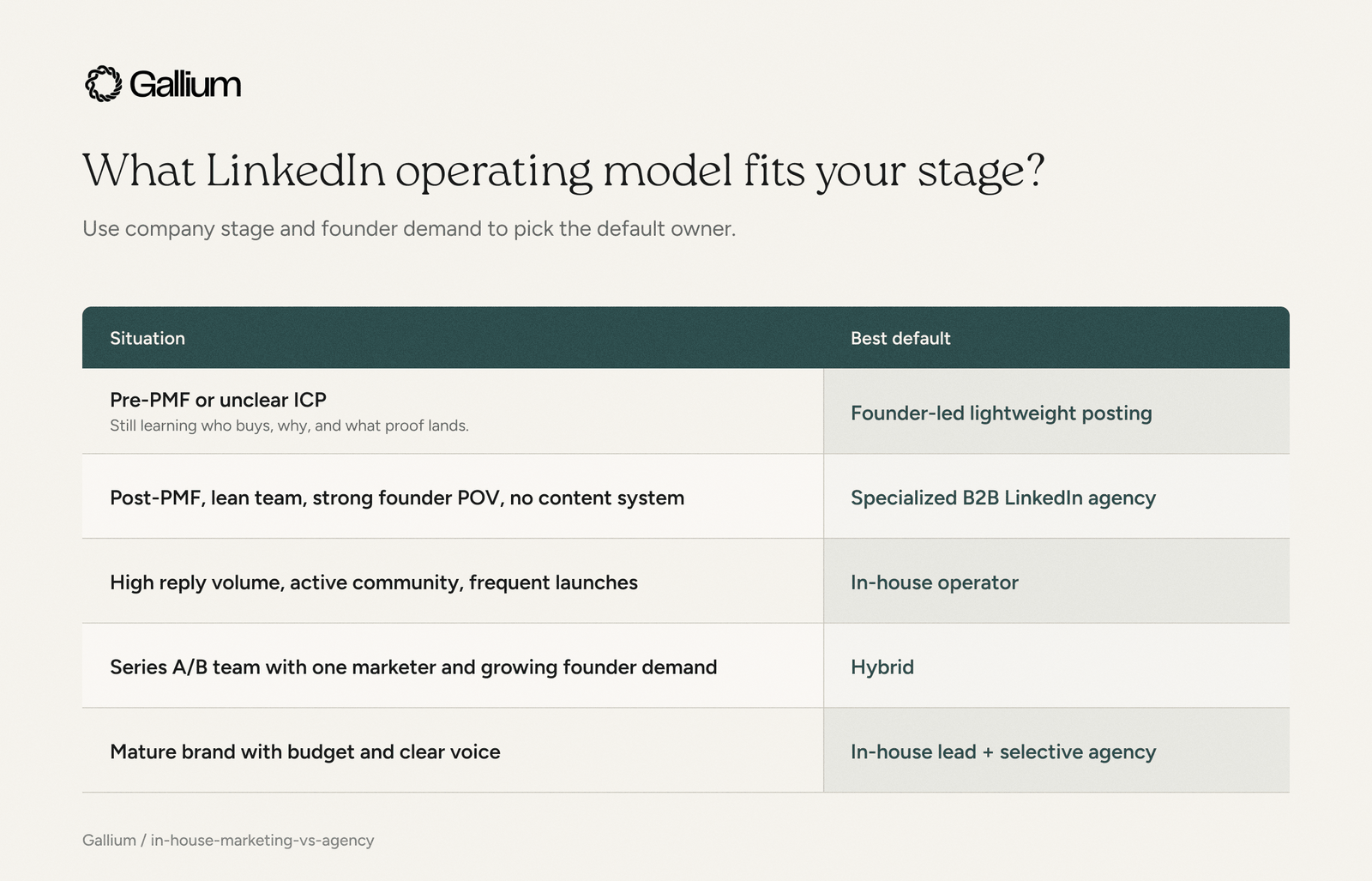
In-house marketing vs agency: a decision matrix by stage
Start with the job, then pick the model.
Frequently asked questions
Should B2B LinkedIn content be managed in-house or by an agency?
B2B LinkedIn content should be managed in-house when speed, internal context, and daily community management matter most. It should be managed by a specialized agency when the company needs a complete content system faster than it can hire one. Many teams eventually use a hybrid.
When should a startup hire a LinkedIn marketing agency?
Hire a LinkedIn marketing agency when you have product-market fit signals, a clear ICP, useful founder raw material, and enough runway to fund consistent work for 6-12 months.
When is an in-house content hire better?
An in-house hire is better when LinkedIn depends on real-time replies, customer context, launches, internal coordination, employee activation, and founder access every week.
Can an agency replace a founder's voice?
No. A good agency can capture, sharpen, and scale founder voice. It cannot replace founder judgment. The founder still needs to supply stories, opinions, taste, and access.
What is the safest first move?
If the company is early, start founder-led. If the company has proof but no system, rent the system through a specialized agency. If the channel starts creating real commercial signals, move toward hybrid.
So, should you hire in-house or an agency?
The best in house marketing vs agency decision is the one that fits the stage you are actually in. A great in-house hire with no access will fail. A strong agency with shallow intake will fail. A founder who wants "thought leadership" but will not say anything specific will fail in either model.
B2B LinkedIn content works when the company has something real to say, a system for capturing it, and enough patience to let the channel compound.
Start there. Then choose the in house marketing vs agency model that fits.