


Content Marketing for Startups: Build a Visibility System, Not a Blog Calendar
Content marketing for startups used to mean publishing enough helpful articles until search traffic started to compound. That version is not wrong. It is just incomplete now.
In 2026, startup content has to do more than rank. It has to make the company's proof visible across the places buyers now research: founder posts, operator threads, Google, AI answers, sales follow-up, community threads, comparison pages, and private buying conversations.
Content marketing for startups is the process of turning founder judgment, customer proof, and buyer questions into reusable assets that help people trust the company before a sales call. The goal is not more blog posts. The goal is to make the startup's best evidence easier to discover, share, cite, and act on.
The market changed: generic startup content has nowhere to hide
AI made clean writing cheap. Any startup can now generate a competent post on "10 content marketing tips for startups" in a few minutes. That doesn’t make the post useful.
Buyers are also doing more research before they talk to sales. Recent B2B buying research points in the same direction: buyers want more useful proof before they spend time with sales, and AI is becoming part of that research path. Buyers still want help. They just want proof before they spend time with a seller.
That is why founder-led distribution matters more, not less. Buyers do not only evaluate the company site. They watch how the founder thinks in public, which operators explain the market clearly, who gets cited by peers, and which ideas travel through the professional graph before a sales call ever happens.
Search is changing too. Google has expanded AI Overviews and introduced AI Mode, which uses query fan-out to search across related subtopics and assemble answers with links to web content. Startups are no longer optimizing only for a blue-link ranking. They are trying to become a source that people, search systems, and AI systems can retrieve.
AI search does not make weak content stronger. It makes weak proof easier to expose. If the company has no clear founder POV, no useful pages, no external mentions, and no public trust signals, there is not much for buyers or machines to retrieve.
So the failure mode is not "we need a better calendar." It is weak source material, weak proof, weak retrieval, and weak handoff to sales.
The new startup content system: source, proof, surface, feedback
For systems thinkers and engineers, the useful model is source, proof, surface, feedback.
Source comes from places like Gong or Fireflies call transcripts, podcasts, customer language, product demos, objections, and internal workflows.
Proof is the asset layer: examples, teardown posts, screenshots, case studies, benchmarks, docs, and point-of-view essays with real tradeoffs.
Surface is where buyers find it: SEO pages, founder posts, X Articles, sales follow-up assets, resources, docs, and comparison pages.
Feedback comes from GSC, Ahrefs, LinkedIn replies, X bookmarks, CRM notes, sales-call references, and buyer-signal tools like Common Room.
Gallium goes one layer deeper. We train our own model on 40M+ marketing posts, then combine that pattern data with founder interviews, SEO/AEO research, and live performance feedback. That is how we know what to turn into a founder post, what belongs on an answer-ready page, and what should become sales proof instead of another generic article.
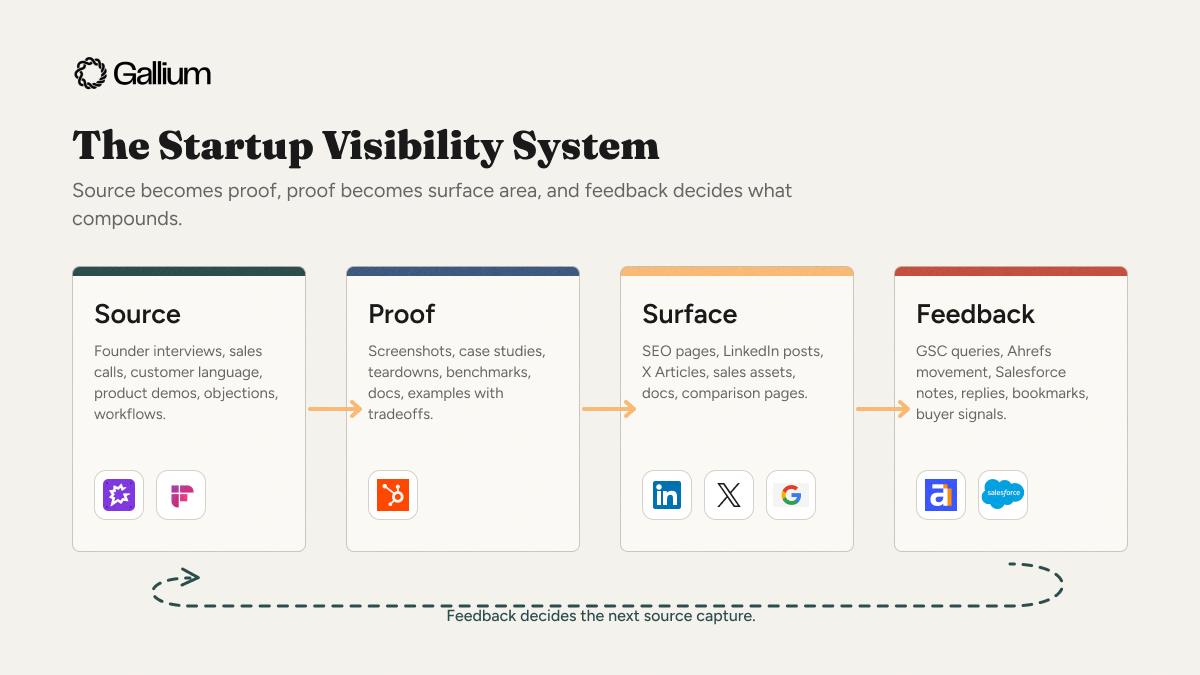
A startup content system should connect source, proof, surface, and feedback instead of treating each channel as a separate task.
Founder judgment is the category signal
Founder-led marketing is not valuable because the founder has a personal account. It is valuable because early markets are usually under-explained.
Before a category has stable search volume buyers are still trying to decide what the problem is called and which tradeoffs matter. The founder is often the only person close enough to name that clearly.
That is the source material: why customers keep getting stuck, what they are using as a workaround, which objections are fake, which objections are real, where the market is moving, and what proof would change a skeptical buyer's mind.
The content team's job is to turn that judgment into assets: a founder post, a buyer-question page, a comparison section, a sales follow-up resource, or a proof page. The team can package the thinking but it still depends on capturing the founder's intuition.
That is why the founder is the first distribution surface for the company's judgment. Not because every founder needs to become an influencer, but because in an early market, the founder is usually the clearest signal of how the company sees the problem.
Founder-led content and SEO should not be separate motions. Founder posts test the language. Sales calls reveal the objections. SEO turns repeated questions into durable pages. Performance data shows which proof actually moves the conversation.
For the LinkedIn-specific version, Gallium's deeper guide on founder-led LinkedIn content strategy is the better place to go next.
What startups should publish first in 2026
Most startups do not need to start with a full blog calendar. They need a small set of proof assets that work across search, social, and sales.
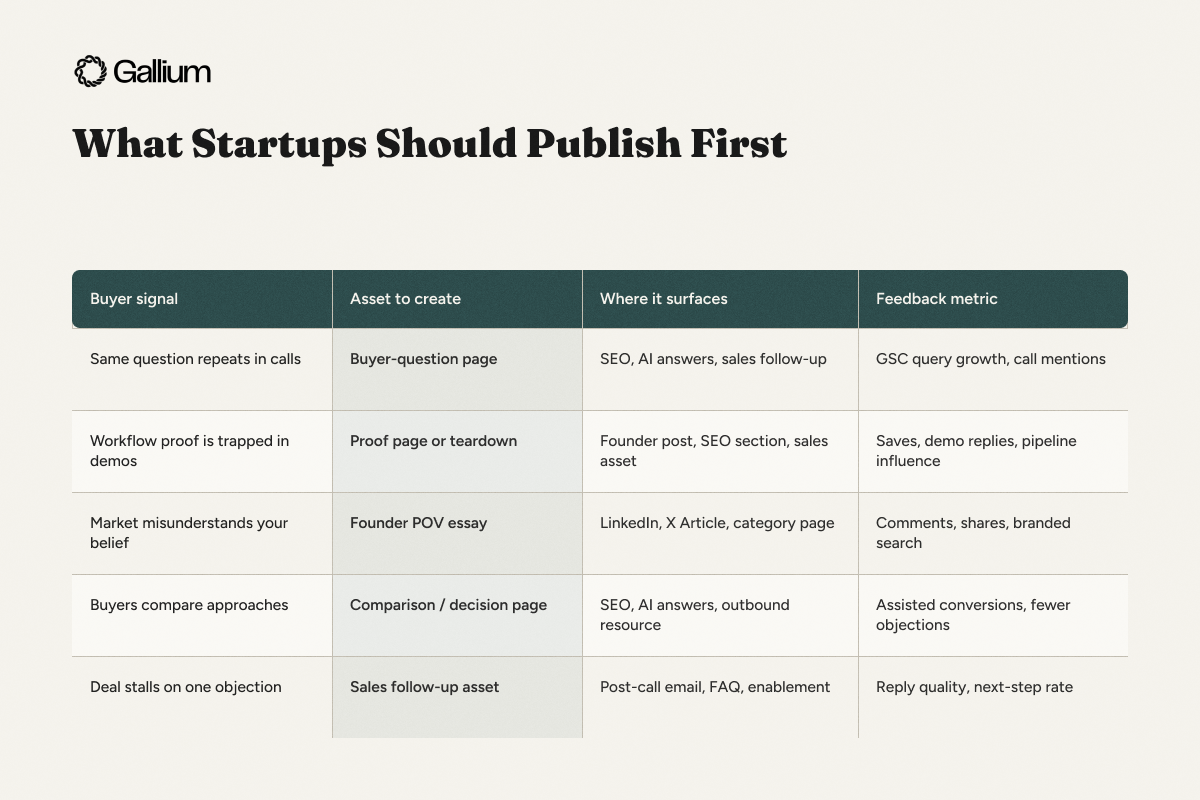
Use the strongest buyer signal to decide which asset to publish first, then measure whether it changes search, social, or sales behavior.
Start with buyer-question pages. These answer what prospects already ask on sales calls, in DMs, in communities, and in search. They should be direct, specific, and structured enough for humans and AI systems to understand.
Then build proof pages: case studies, teardown posts, workflow breakdowns, screenshots, benchmarks, implementation notes, or example libraries. The goal is to show the operating reality behind the claim.
Add founder POV pieces when the company has a belief the market needs to understand. These should explain a hard-earned point of view: what the team believes, what it rejects, what changed in the market, and what buyers should do differently.
Comparison and decision pages matter too. Early buyers are often deciding between approaches before they decide between vendors. If your startup can explain when to use one approach versus another, you help the buyer make progress before they ever book a call.
Finally, create sales follow-up assets: objection pages, checklists, resource docs, implementation notes, and "how this works" explainers.
Search compounds when the startup becomes citable
Search still matters, and it may matter more now, but ranking is no longer the only visibility surface. Startups need to be retrievable, quotable, and useful inside AI-mediated research.
That does not mean stuffing pages with "AI search" language. AI-search visibility appears when the company has enough authoritative, linked, specific, and structured evidence for systems to retrieve.
Classic SEO still matters. Build crawlable pages, clear headings, internal links, backlinks, topical depth, search demand, and pages that answer real questions.
Community and social proof matter too because buyers and AI systems both look beyond the company site.
The best answer-ready pages define the problem, answer the question directly, give examples, explain constraints, compare approaches, cite real sources where needed, and include proof the company actually understands the work.
Distribution is now proof-led, not channel-led
The best startup distribution is not "post everywhere." It is turning one proof asset into the right surfaces, starting with the people buyers already trust.
This is already obvious in AI and devtool markets. The strongest companies are turning docs, X Articles, staff-led demos, launch videos, architecture notes, benchmarks, and internal workflows into public proof.
Our devtool marketing research found the same pattern: docs are becoming marketing infrastructure, X Articles are acting like technical blogs inside the feed, and technical staff are becoming the launch surface.
The AI GTM market is moving in a similar direction. Automation claims are cheap. Revenue proof, workflow specificity, and visible operator judgment are what buyers inspect.
For most startups, that means the distribution plan should start with the proof, not the channel. A customer workflow might become a founder LinkedIn post, sales follow-up page, SEO section, teardown, and short video. A repeated objection might become a blog section, FAQ, outbound resource, and internal enablement note.
The point is making the same proof available wherever the buyer is already forming trust.
When to hire, outsource, or systematize
Most early-stage startups do not need a full-time content hire on day one. They need the operating layer before they need the hire.
That layer includes source capture, buyer-question mapping, answer-ready pages, founder-led distribution, internal links, sales follow-up assets, and feedback loops. Whether that is owned by a founder, a fractional operator, a specialized team, or a future hire depends on stage and volume.
If the ICP or offer language is still unclear, stay close to direct conversations and founder-led learning. If the founder has signal but no system, build an AI-assisted capture and repurposing workflow. If strategy and source material are already clear, freelance production can help. If the startup needs a repeatable cross-channel visibility system, a specialized pod or agency can make sense.
For the broader resource-allocation decision, use Gallium's guide to the in-house marketing vs agency tradeoff.
How Gallium builds this visibility system
Gallium is built around this diagnosis. We help founder-led teams capture founder judgment and sales/customer signal, model buyer questions and market language, turn proof into SEO and AEO pages, distribute the strongest ideas through founder-led LinkedIn and X, and use performance feedback to decide what to refresh, expand, or stop.
The work starts with the leak. Sometimes the source material is weak. Sometimes the proof exists but is not findable. Sometimes search visibility is growing but there is no conversion path. Sometimes social attention never turns into sales learning.
Gallium helps founder-led teams turn source material into search-ready pages, founder-led distribution, and proof loops that show what is actually moving pipeline. Book a call if you want help deciding which part of the system to fix before you build another content calendar.
Frequently asked questions
What is content marketing for startups?
Content marketing for startups is the process of turning founder judgment, customer proof, and buyer questions into reusable assets that build trust before a sales call. In 2026, that includes SEO pages, AI-answer-ready content, founder-led distribution, and sales-ready proof.
What should a startup publish first?
Start with buyer-question pages, proof assets, founder POV pieces, comparison pages, and sales follow-up resources. Avoid generic tips until the company has clear source material and a reason to own the topic.