


Aidan Nguyen-Tran - Growth Lead at Gallium
Content engineering is the AI-native evolution of content marketing. Content marketers still decide what the market needs to understand, believe, and do next. Content engineers treat content as one cohesive system instead of a set of channel silos:
TL;DR
- Content marketing used to be judged mostly by campaigns and assets. AI moved the bottleneck to inputs, systems, proof, reuse, and refreshes.
- Content engineering is the operating layer that modern content marketing now needs: source capture, brief structure, prompt constraints, QA, distribution reuse, and performance learning across channels.
- Companies shouldn't be debating whether they need a marketer or a content engineer. The question is whether their content marketing has evolved into an engineering workflow.
A year ago, a marketer might say, "We need a campaign around search and visibility." That was usually enough to start: pick the topic, write the page, repurpose the post, and move on.
Today it has evolved to content engineering. This role is not a new department floating beside content marketing. It is what content marketing becomes once the work depends on structured inputs, AI-assisted production, multi-surface distribution, and a feedback loop that connects the work back into one system.
For the broader role definition, read what a content engineer does.
Content marketing grew an operating layer
Traditional content marketing starts with market communication. It asks who the audience is, what the company should say, which campaign should run, which channel matters, and what proof the market needs to believe.
Content engineering keeps those questions and adds the infrastructure underneath them. It asks where the source material lives, how briefs are structured, which claims are approved, how AI is constrained, how drafts are reviewed, how one idea travels across channels without splintering, and what changes after the asset ships.
The simplest way to see the difference is to compare the job each role is trying to protect:
| Criterion | Traditional content marketing | Content-engineered marketing |
|---|---|---|
| Core question | What should the market believe or do? | How do we make the right content repeatable, safe, and useful? |
| Owns | Audience, positioning, campaign, offer, distribution | Source base, briefs, workflows, QA, reuse, refreshes |
| Main output | Positioning, campaigns, editorial choices, channel plans | Knowledge base, prompt specs, review gates, templates, feedback loop |
| Failure if missing | Content is efficient but generic or off-position | Strong ideas stay trapped in one-off execution |
Both sides matter. The first protects market truth. The second protects repeatability.
Most AI-native teams need both responsibilities. A marketer gives the system a sharp market message, and the content-engineering layer makes that message repeatable across briefs, review gates, reuse, and feedback loops. That work is not just technical. It still requires taste, because the system owner has to decide what should stay consistent, what should change by channel, and when a technically correct draft is still strategically weak.
A strong content engineer needs taste, positioning, and editorial judgment. The distinction is about the center of gravity: one role starts from market meaning, the other from system coherence.
This shift happened because first drafts got cheaper. When whole teams are drafting content, the value moves to the material around the draft: founder POV, customer language, proof, review, reuse, measurement, and refreshes. The content engineer's job is to keep those pieces from becoming separate silos.
Where content engineering systems break
Content engineering breaks when teams collapse two decision domains into one vague AI-content job and assume the tool will cover the gap.
It usually does the opposite.
When the marketer is forced to own the whole system, the team gets more drafts and more cleanup. Each employee has their own prompts and claims drift. Similar to coding, AI content writing multiplies the output of bad content.
We've seen teams ship technically clean content that does not move buyers. The workflow works, but the message is flat. Pages are well structured, but the claim is generic. The article is source-backed, but it does not change how the reader thinks about the category.
You can usually see the failure before the content ships:
| If market judgment is missing | If system ownership is missing |
|---|---|
| The content is accurate but forgettable | The content is sharp once, then disappears |
| Positioning gets inferred from old docs | Every brief starts from a blank page |
| Distribution choices become mechanical | Review depends on whoever has time |
| The page answers the keyword, not the buyer | AI scales generic claims faster |
| Sales objections never become content | Performance data never changes the workflow |
The founder-facing version is simpler. If nobody can say who owns the brief, the source base, the approval bar, and the refresh loop, AI usually increases output before it increases trust.
This is why content engineering is a real evolution of content marketing. The job didn't stop being about taste, positioning, and audience judgment. It gained an operating layer that keeps the whole content system aligned.
When to combine, split, or rent the systems layer
Most early-stage teams shouldn't rush to create two titles. A seed-stage founder-led company usually has a bigger narrative problem than an org design problem. The company is still learning what buyers care about, which message lands, what language feels true, and which channels matter.
At that stage, one strong content lead can own both responsibilities. The key is to name the second responsibility instead of hiding it inside "write more content." Someone has to maintain the source base, brief structure, review checklist, reuse map, and refresh rhythm.
The split starts to make sense when both story quality and system reliability create meaningful weekly work.
| Situation | Best default | Why |
|---|---|---|
| Early founder-led team with unclear narrative | Combine under one strong content lead | The problem is still ambiguity, not systems debt |
| Weekly bottlenecks around briefs, QA, reuse, or refreshes | Split narrative ownership from systems ownership | Both story and system now matter every week |
| Painful but narrow systems gap | Rent fractional content engineering | Fix the operating layer before committing to a new title |
| Regulated, multi-product, or multi-channel team | Split earlier | Governance cost rises faster than writing volume |
The useful rule is simple: keep one owner while the problem is ambiguity, split the work when story and system both matter every week, and rent the systems layer when the bottleneck is real but not yet permanent.
That last option matters for founders. Hiring a full-time content engineer before the narrative is clear can create a polished machine with nothing distinct to say. Expecting a storyteller to quietly own automation debt forever creates the opposite problem: strong ideas buried under scattered docs, fragile prompts, and manual review.
Forward-deployed content engineering is often the bridge. It can clean up the knowledge base, brief format, review gates, internal links, repurposing paths, and refresh process while the marketer or founder keeps owning the market judgment.
The wrong takeaway is that content marketing is obsolete
The chart is easy to misread if you treat it like a replacement story. It is not saying content marketers disappear. It is showing two things at once: content marketing remains the broader category, and content engineering becomes a real specialist lane because AI adds systems work that used to stay hidden inside the marketing job.
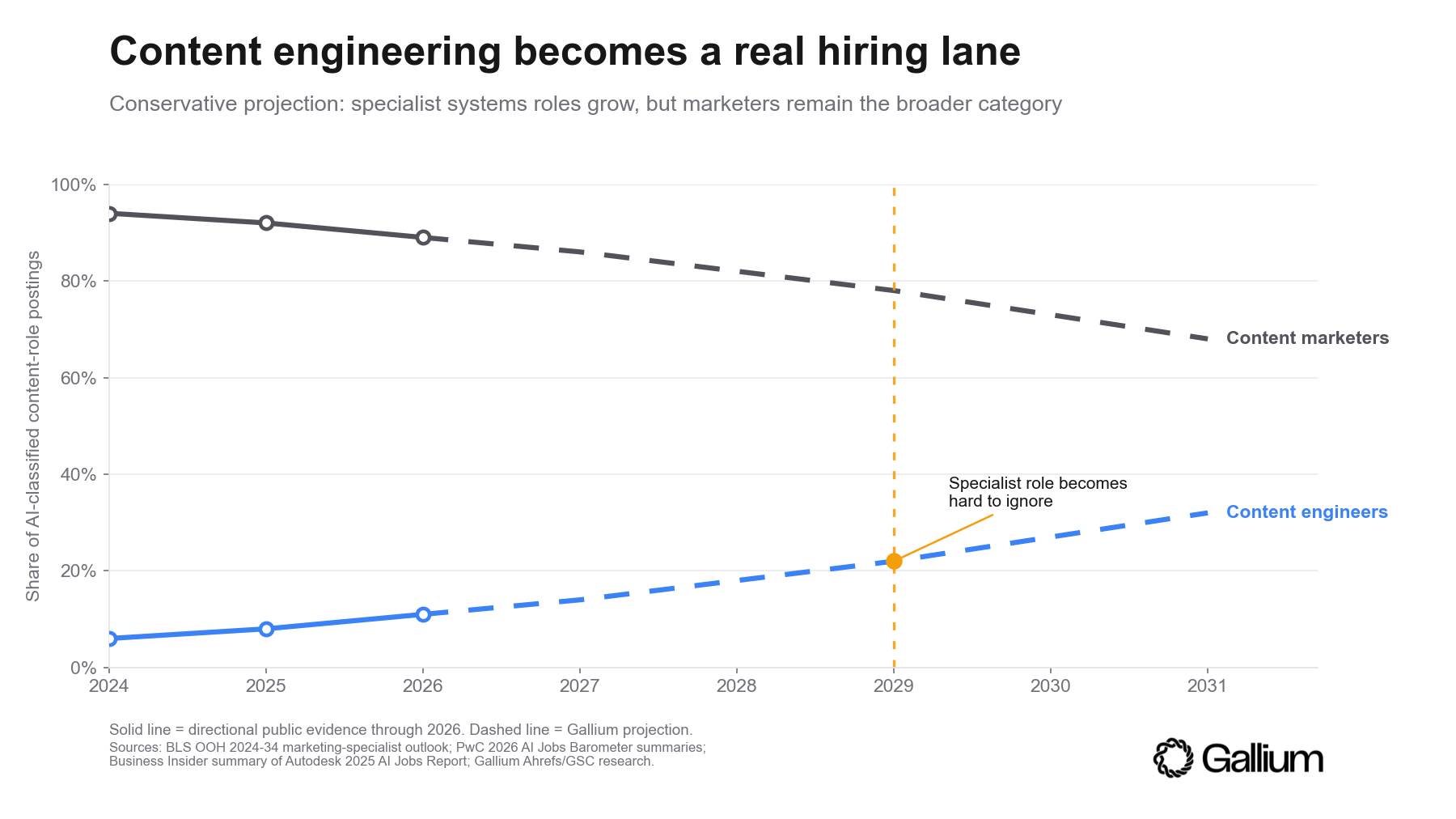
The wrong takeaway is, "AI replaces the marketer." The stronger read is that AI makes marketing judgment more valuable. A weak message does not become stronger because it moves through a better workflow. It just becomes weak in more places, faster.
That is why the two lines can move in opposite directions without contradicting each other. Content marketing decides what the company should mean in the market. Content engineering makes that meaning durable enough to travel across search, AI search, social, sales, and refresh cycles without turning into five disconnected versions of the same idea.
For founders, the practical question is not which title sounds more modern. It is where the content process is breaking. If every asset still depends on the same few people remembering the right source, claim, voice, approval bar, and distribution path, the issue probably is not writing capacity. It is a systems gap.
Gallium can help map that gap. Book a 30-minute content systems audit and we will answer three questions: whether you have a message problem, a workflow problem, or both; which responsibility should stay with the marketer or founder; and which parts of the content-engineering layer need to be built before output scales.
FAQs
Is a content engineer replacing a content marketer?
No. Content engineering evolves content marketing; it doesn't erase strategy, positioning, audience insight, or taste. The content-engineering layer adds the operating system that helps those ideas become repeatable content across channels without breaking into silos.
Can one person be both?
Yes. In early-stage teams, one person often owns both message and system. The risk isn't shared headcount. It's unclear ownership of the brief, source material, QA rules, reuse paths, and refresh loop.
When should a startup split the roles?
Split the responsibilities when both narrative quality and workflow reliability create recurring weekly work. Rent the systems layer first if the pain is real but not yet permanent.