


Aidan Nguyen-Tran - Growth Lead at Gallium
I keep seeing the same failure mode in founder-led B2B teams: the company knows more than its content system can remember.
The founder explains the category clearly. Customers repeat the same objections. The company has real proof. Then the next brief starts from zero again.
That is not a writing problem. It is a memory problem.
Most teams try to solve it by adding more people or more channels: a writer, then a social lead, then a ghostwriter, then an agency. Output goes up, but the system does not get smarter. The same positioning nuance gets re-explained. The same customer proof gets rediscovered. The same working language disappears between posts.
At Gallium, we call the missing layer a central brain: one place where voice capture, customer proof, topic models, custom prompts, and performance feedback loops compound instead of getting rebuilt every week.
The Content Engineer is the person who builds and runs that brain, backed by data and experimentation.
We have run this model across 20+ founder-led B2B companies and 300M+ impressions, and we have analyzed more than 40M posts to understand what actually performs across channels.
The lesson is simple: content does not scale because a team writes more. It scales when the team stops treating every founder interview, customer proof point, post, article, and thread as a fresh start.
Gallium uses that performance data to train content models around what each market responds to: the hooks that earn attention, the claims that need proof, the topics that travel across channels, and the founder voice patterns worth preserving.
In this piece:
- What a Content Engineer does
- How the role differs from a strategist, freelancer, or content marketer
- Why AI search, SEO, and multi-channel publishing made the role more important
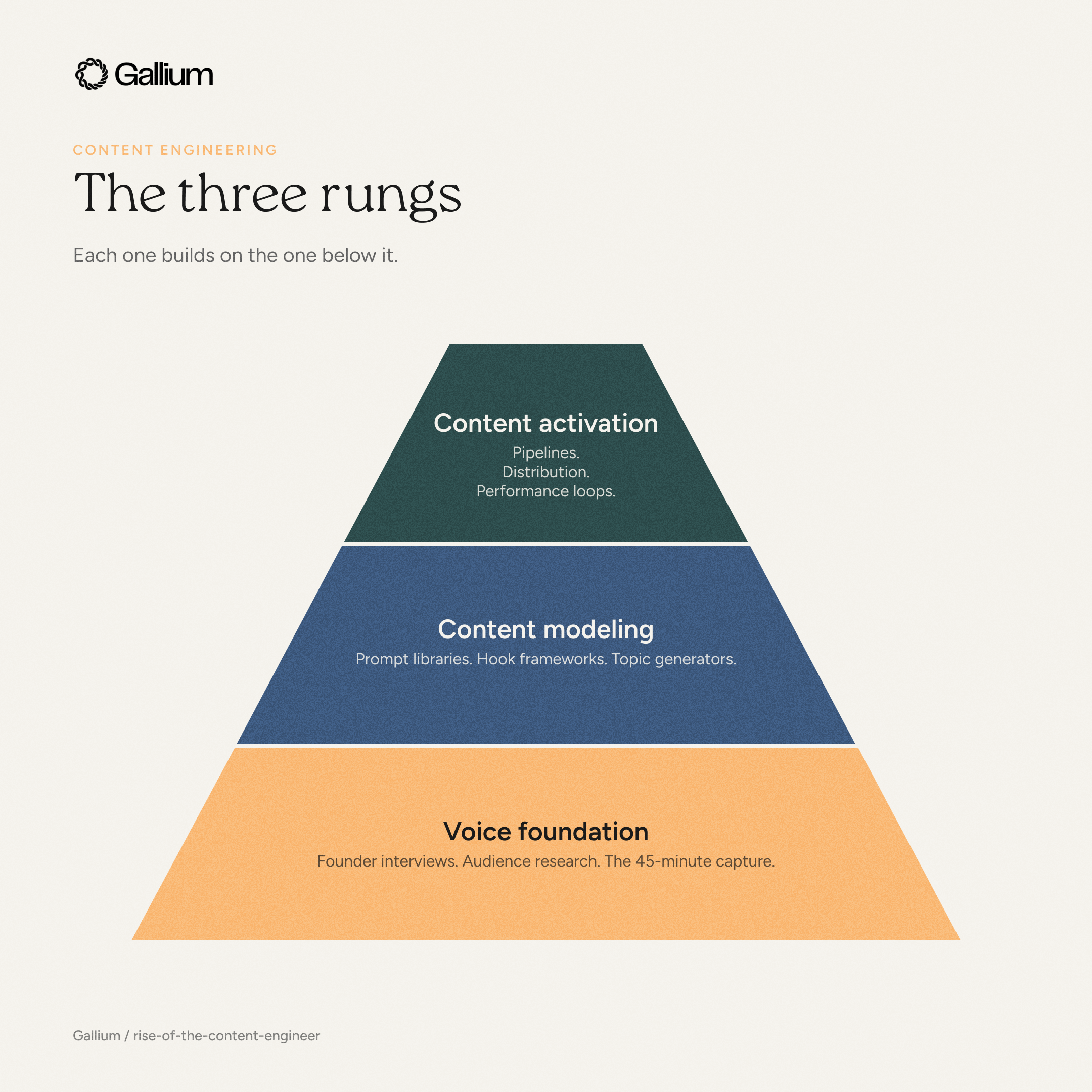
- The three rungs of content engineering: voice foundation, content modeling, and content activation
- How to decide whether to hire in-house or use a forward-deployed content engineering team
What does a Content Engineer do in B2B marketing?
A Content Engineer builds the system behind the content.
That means turning founder interviews into reusable voice profiles, customer calls into proof libraries, and performance data into better briefs. It also means building prompts, review workflows, and channel pipelines around the company's actual positioning instead of generic thought-leadership patterns.
The point is not that the Content Engineer uses AI. Anyone can use AI.
The difference is that they design the system around it: source material, retrieval, voice rules, approval loops, performance feedback, and channel-specific publishing workflows.
The role is not just automation
Automation is useful, but it is the least interesting part of the job.
A weak content system asks, "How do we generate more posts?"
A strong content system asks:
- Which founder beliefs should the market associate with us?
- Which customer stories prove those beliefs?
- Which topics should we own in search and AI-generated answers?
- Which claims need citations, examples, or original data before we publish them?
- Which channels should learn from each other instead of operating as separate calendars?
The Content Engineer owns those questions as a system. They are not replacing taste with tooling. They are making the company's best judgment repeatable enough to publish more without sounding like every other AI-assisted brand.
The analogy we keep coming back to is from software. A Content Engineer is to marketing what a DevOps Engineer was to software. Before DevOps, shipping code was a bottleneck. Engineers wrote the code, someone else figured out how to get it live. Then a role emerged that owned the system between them — CI/CD and environments and observability — and the whole industry got faster.
That person is the Content Engineer.
Why AI search and multi-channel publishing changed content marketing
Two changes made this role urgent: AI made content easier to produce, and the number of places a brand must show up kept expanding.
AI lowered production costs and raised the cost of bad inputs
AI did not make content strategy easier. It made weak strategy louder.
A marketer with a decent setup can produce a month of drafts in an afternoon. That sounds like leverage until the drafts all miss the founder's voice, flatten the positioning, invent unsupported claims, or repeat whatever the category already believes.
The bottleneck moved from production to inputs.
What matters now is whether the system has:
- A documented founder voice, with real phrases, banned phrases, argument patterns, and examples.
- A library of customer proof, including quotes, objections, outcomes, and use cases.
- A point of view on the category that is sharper than "AI is changing everything."
- Review loops that catch factual drift before content goes live.
- Performance data that improves future topics instead of sitting in a monthly report.
That is why "more AI content" is usually the wrong answer. The better answer is better source material, better retrieval, better workflows, and better judgment around what deserves to be published.
Channels, platforms, and search surfaces now affect each other
B2B content no longer lives in separate channel plans.
Your LinkedIn posts can shape what buyers search for. Your blog can become source material for ChatGPT, Perplexity, Google AI Overviews, and sales calls. Your X posts can surface category language before it becomes a formal keyword. Your newsletter can test a claim before it becomes a landing page. Your customer story can become a sales proof point, a search snippet, and a founder post.
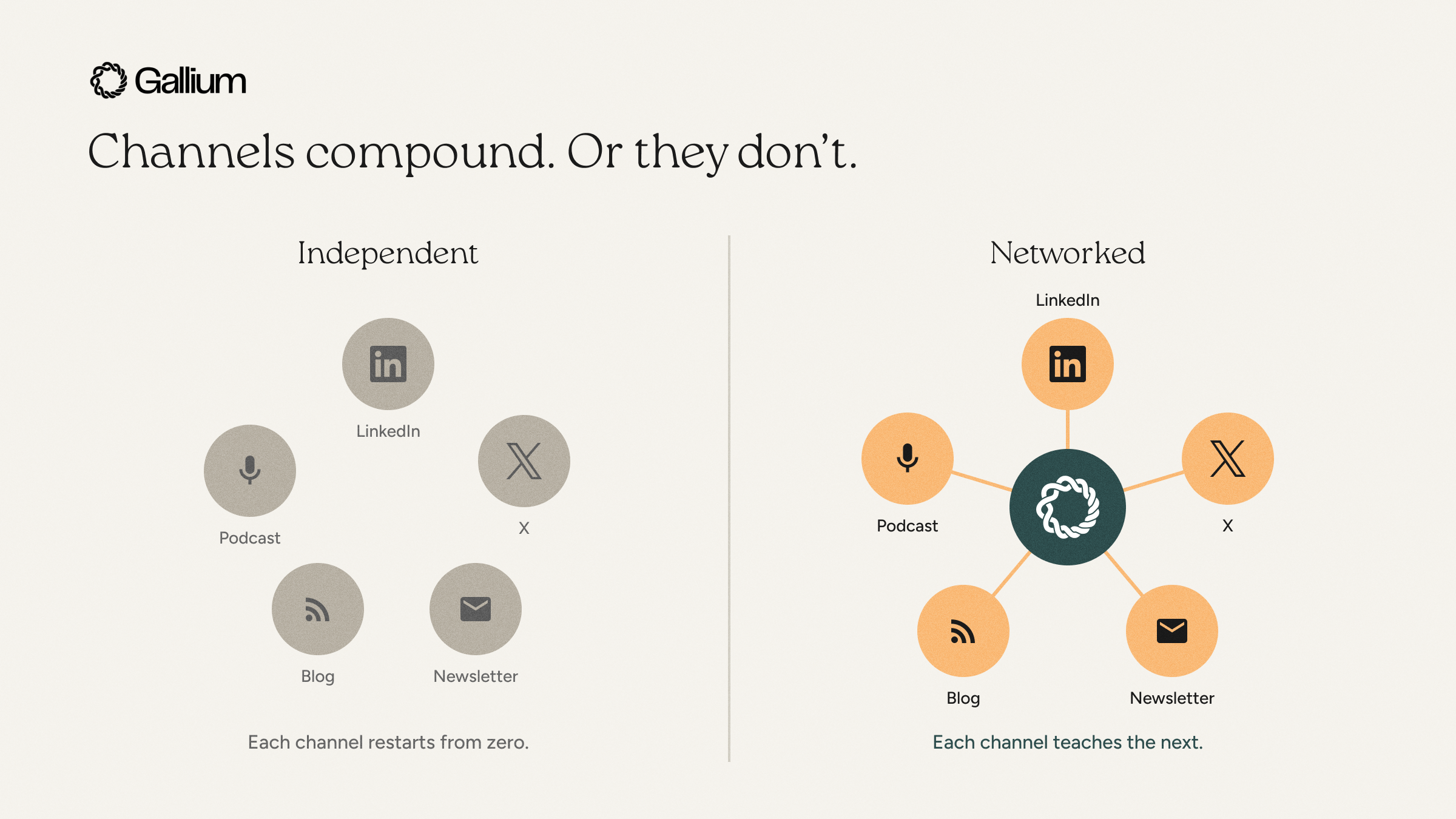
The mistake is treating each platform like a separate content calendar.
When LinkedIn, X, SEO, newsletter, video, and AI search are managed independently, every channel starts from zero context. The founder repeats the same ideas. The content team redoes the same research. The brand never builds a memory.
A Content Engineer makes those surfaces share context.
Gallium rule of thumb: if a founder says something sharp once, the system should know where it belongs next: LinkedIn, X, newsletter, blog, sales enablement, AI-search answer, or customer proof library. If the team has to rediscover that quote three weeks later, the system failed.
The three rungs of content engineering
Most AI content programs start with activation: prompts, calendars, workflows, scheduling, repurposing. That is why so many of them sound the same.
The Content Engineer has to build from the bottom up.
The strongest publishing systems start with voice and proof before they scale output.
Rung 1: voice foundation
Voice foundation is the soil where you plant your content.
This is not a brand-voice adjective list. "Smart, direct, confident, conversational" does not help a model sound like a founder. A real voice foundation captures how the founder thinks.
At Gallium, the first pass usually includes:
- A 45-minute founder voice-capture session.
- The founder's recurring beliefs, contrarian claims, and category language.
- Phrases they use naturally and phrases they would never say.
- Stories they repeat on sales calls, podcasts, investor calls, and customer conversations.
- Archetype customers and the language those customers use.
- Proof points: revenue moments, customer quotes, adoption signals, market data, and objections.
- Example posts or essays that do and do not sound like the founder.
Good marketers already care about voice, positioning, audience, and proof. The gap is that most teams never turn those inputs into a system. Voice capture stays in notes. Customer proof stays in calls. Topic decisions stay in someone's head. Performance data shows up in reports, but rarely changes the next brief.
That is the Content Engineer's job: build the voice model, topic model, custom prompts, and feedback loops that make the team's best judgment repeatable.
Callout for founders: the 45-minute voice session is not a copywriting exercise. It is the artifact that teaches every downstream prompt, brief, editor, and channel what "sounds like us" actually means.
Rung 2: content modeling
Content modeling is where the system stops sounding generic.
Once voice capture is done, the next job is to decide how the system should think. That usually means:
- Custom prompts tuned to the founder's argument style.
- Hook patterns based on what actually performs in the category.
- Topic maps tied to ICP pain, search intent, and sales objections.
- Competitive gaps that show what the market keeps over-saying or under-explaining.
- Proof libraries so claims pull from customer stories, not generic category language.
- QA rules for claims, citations, voice drift, and channel fit.
This is the part most teams underbuild. They buy tools, write a few prompts, and call it a system. But the prompt is only as good as the source material behind it, the examples it learns from, and the claims it is allowed to make.
We have refined this layer across AI infrastructure, fintech, biotech, and VC. The prompts are not the durable asset. The source system behind them is.
Rung 3: content activation
Activation is where the system publishes.
This includes the channel pipelines: LinkedIn, X, blog, newsletter, carousels, short-form video, podcasts, sales enablement, and AI-search-friendly explainers. It also includes human review where judgment matters: positioning, factual accuracy, sensitive claims, customer proof, and founder taste.
The spiky version: "human in the loop" is too vague to be useful. The real question is which human, at which step, making which decision.
For us, the human review points usually look like:
- Founder or executive review for point-of-view accuracy.
- Content engineer review for voice, source material, and channel fit.
- Strategist review for positioning, ICP relevance, and funnel role.
- Final QA for links, citations, claims, and asset formatting.
Performance then flows back into rung 2. If a topic pulls high-quality replies on LinkedIn, it may deserve a blog. If an X thread surfaces better language than the original brief, that language goes back into the model. If a blog gets cited by AI search, the answer pattern becomes part of future content planning.
That is where content systems get stronger over time.
How to structure the Content Engineer role
The role is showing up under several names: Content Engineer, Marketing Engineer, AI Content Ops, Growth Content Lead, Content Systems Lead. The title matters less than the operating model.
There are two practical ways to structure it.
Model 1: hire an in-house Content Engineer
This works when the company already has a mature content function.
You probably need:
- A content team of five or more.
- Enough channel volume to keep a technical operator fully utilized.
- A senior marketing leader who can manage a hybrid strategy-and-systems role.
- Access to engineering, RevOps, analytics, and brand leadership.
- Budget for a senior hire, usually in the $150K-$200K range.
The upside is ownership. The Content Engineer sits close to the team, understands internal politics, and can build tooling around the company's exact workflows.
The risk is underutilization. If the company does not have enough source material, distribution volume, or executive buy-in, the role becomes an expensive prompt writer.
Model 2: use a forward-deployed content engineering team
This is not a fancy name for a freelancer.
A freelancer sells output. A consultant sells advice. A forward-deployed content engineering team installs the operating system: voice foundation, content model, workflow, QA, reporting, channel activation, and iteration.
The difference is shared infrastructure.
One founder-led company should not have to invent the same voice-capture process, prompt QA system, topic model, performance loop, and repurposing workflow from scratch. A forward-deployed team brings patterns from other deployments, adapts them to the company, and works inside the actual marketing motion.
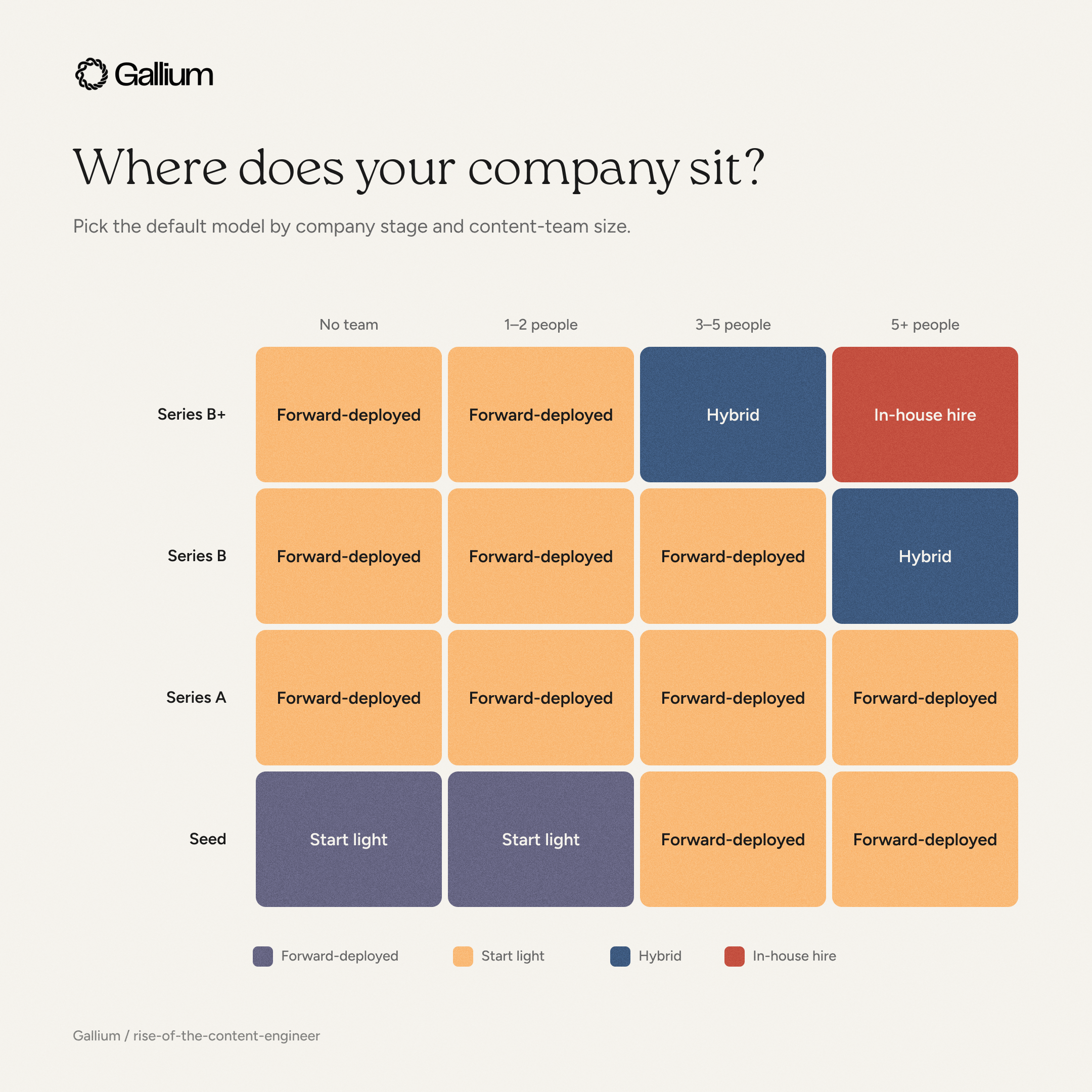
This is usually the better fit for seed to Series B companies that need founder-led content, SEO/AEO visibility, and multi-channel distribution before they can justify a full in-house systems hire.
Stage matters less than whether the company has enough content infrastructure for a full-time systems owner.
A practical decision framework
Choose an in-house Content Engineer when your content team is already publishing across multiple channels, has clear executive buy-in, and needs a permanent systems owner.
Choose a forward-deployed Content Engineer when the founder's voice is still the main source of authority, the team is small, and the company needs to install the system while learning what actually performs.
Gallium proof point: across our portfolio, the fastest wins usually do not come from publishing more. They come from reducing founder context loss: capturing the founder's voice once, turning customer proof into reusable source material, and making every channel pull from the same strategic memory.
The next actionable question is simple: where does your content process lose the most context today?
If the answer is "inside the founder's head," start with voice foundation. If the answer is "inside scattered calls and customer stories," start with proof capture. If the answer is "inside disconnected channel calendars," start with content activation.
Where the Content Engineer role is heading
Three predictions.
1. Content Engineer becomes a real hiring category
We are already tracking roles across Content Engineer, Marketing Engineer, AI Content Ops, Growth Content Systems, SEO/AEO, and AI Search. The job titles are messy because the market is still naming the work.
That is normal. "Growth" went through the same blur before companies understood the difference between growth marketing, product-led growth, growth engineering, and RevOps.
Our bet is that Content Engineer wins as the clearest name for the person building technical content systems around brand, search, AI, and distribution.
2. The best Content Engineers will come from mixed backgrounds
Most teams lose context between what the founder knows, what customers are saying, and what marketers are able to publish.
That gap is where Content Engineers become valuable.
A lot of companies assume the role means "a marketer who uses AI tools." In practice, the strongest Content Engineers often look more technical than that. They might be a data person, an operator, or a software engineer with strong marketing instincts.
What matters is translation speed:
- Can they turn a customer call into a search page?
- Can they turn a founder take into a repeatable brief?
- Can they look at performance data and know what should change in the workflow?
- Can they move one proof point across LinkedIn, SEO, sales enablement, and AI search without flattening it into generic content?
That is why the role is easy to underestimate. It does not fit cleanly inside one function.
3. Founder voice becomes the scarcest input
AI makes content easier to produce. It makes founder judgment harder to fake.
The scarce input is not writing. It is the founder's specific read on the market: what they notice, what they disagree with, what customers keep repeating, and what proof they have that others do not.
The companies that win will not just publish more. They will build a system for capturing that judgment and turning it into content across search, social, sales, and AI discovery.
Companies that skip it will keep spending more on AI content and wondering why none of it sounds like them.
We will publish a deeper breakdown of the 45-minute voice-capture process soon. Subscribe through the newsletter form at the bottom of this page to get it early.
Why content engineering matters for SEO, AEO, and founder-led growth
The bigger shift is not "marketing is becoming technical." That line is true, but too broad to be useful.
The sharper claim is this: B2B brands now need a content memory.
Search engines, AI answer engines, social platforms, buyers, and sales teams all reward consistency. They need to understand what the company believes, which problems it owns, which proof backs the claims, and which language should be associated with the brand.
That does not happen through isolated posts. It happens through repeated, specific, well-sourced content across the surfaces where buyers learn.
Content engineering is the discipline of building that memory.
The companies that win will not be the ones publishing the most AI-assisted content. They will be the ones with the clearest source material, strongest founder voice, most reusable customer proof, and tightest feedback loop between content performance and content planning.
The Content Engineer is the owner of that loop.
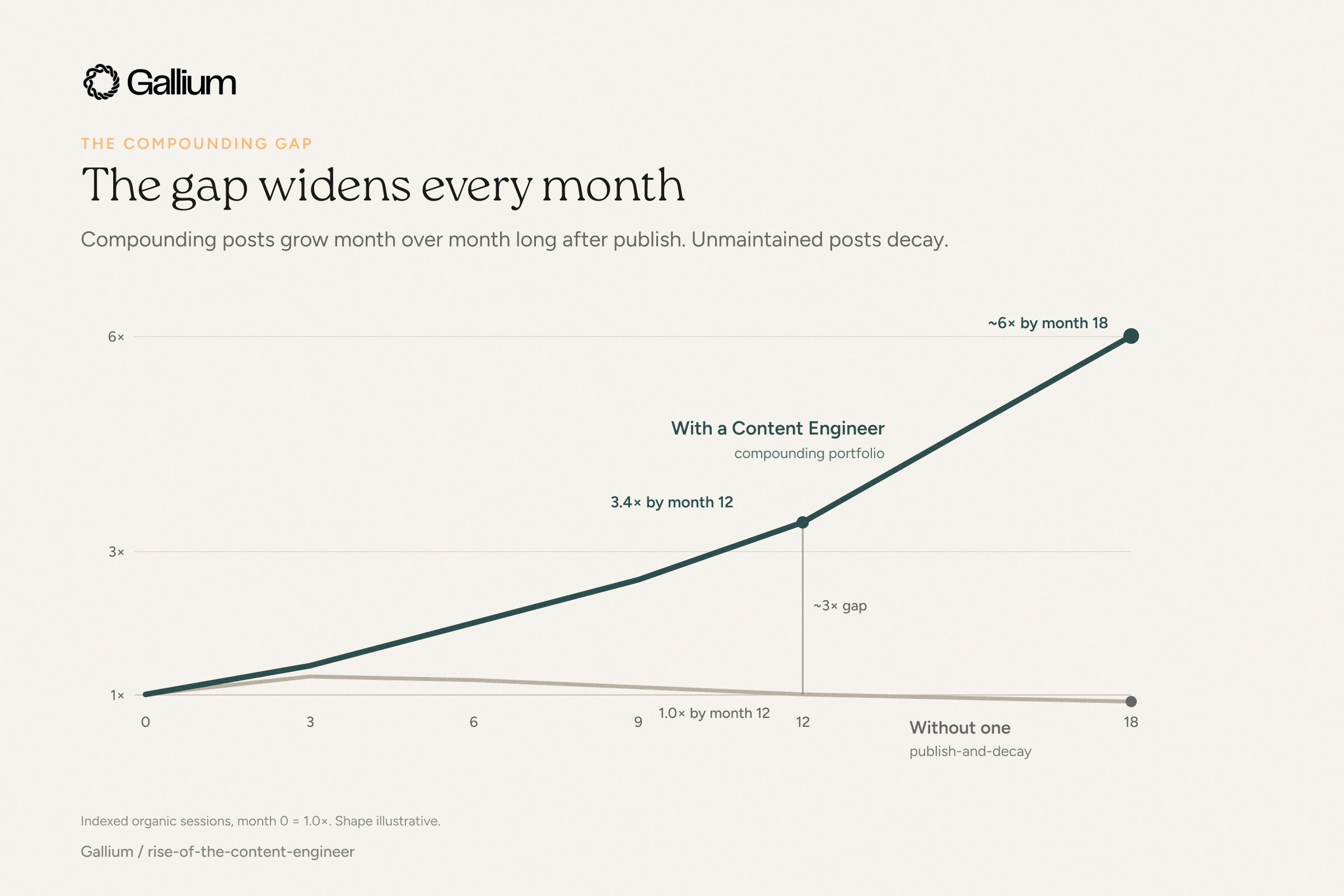
Content systems get harder to catch once the same voice, proof, and ideas show up everywhere buyers research.
Content Engineer FAQ
What is a Content Engineer?
A Content Engineer is a hybrid marketing and systems role that builds the infrastructure behind modern content: voice capture, customer proof libraries, AI-assisted workflows, SEO/AEO topic models, channel pipelines, QA, and performance feedback.
How is a Content Engineer different from a content strategist?
A content strategist usually owns positioning, audience, messaging, and editorial direction. A Content Engineer turns that strategy into a repeatable system. They build the tooling, source libraries, prompts, review loops, and distribution workflows that make the strategy usable every week.
How is a Content Engineer different from a freelancer or agency?
A freelancer usually produces assets. An agency usually owns strategy and execution. A Content Engineer owns the operating system behind the assets: the source material, workflows, governance, and learning loop that make the content function stronger over time.
Do early-stage B2B startups need a Content Engineer?
Not always as a full-time hire. But founder-led startups do need the function earlier than most expect. If the founder is the main source of market insight, the company needs a system for capturing that voice and turning it into content across LinkedIn, X, SEO, newsletters, and AI search.
What should a Content Engineer build first?
Start with voice foundation. Capture how the founder explains the market, the phrases they use, the claims they believe, the proof they can cite, and the customers they are trying to reach. Without that, every downstream prompt and workflow is guessing.
If you are a founder wondering where this role fits your company, start with the context-loss question: where does your content process lose the most valuable information?
Gallium runs forward-deployed content engineering for founder-led B2B companies, backed by 300M+ impressions and more than $10M in attributed pipeline across our portfolio.
Book a 30-minute content systems audit and we will map where your voice, proof, workflows, and distribution loops are breaking down today.
Subscribe to the Gallium newsletter through the form below. We publish the playbooks, case studies, and frameworks that content engineers use to build the system from scratch.