


How LinkedIn Organic Reach Actually Works in 2026
LinkedIn organic reach in 2026 is decided mostly in the first 60 to 90 minutes after you post. LinkedIn shows a post to a small slice of your network, usually 2 to 5%, then expands or kills distribution based on whether people save it and leave real comments. Likes barely move it.
That happens because of the machine underneath. In early 2026 LinkedIn replaced its patchwork of ranking models with one AI system, 360Brew, that reads what a post means and matches it to your profile. Reach stopped being about follower count and started being about whether the right people find a post worth saving or discussing.
The short version:
- The first 60 to 90 minutes decide whether a post travels or dies.
- Saves and comments drive reach. Likes are the weakest signal.
- One save is worth roughly 5x a like, per AuthoredUp's read of 3M+ posts.
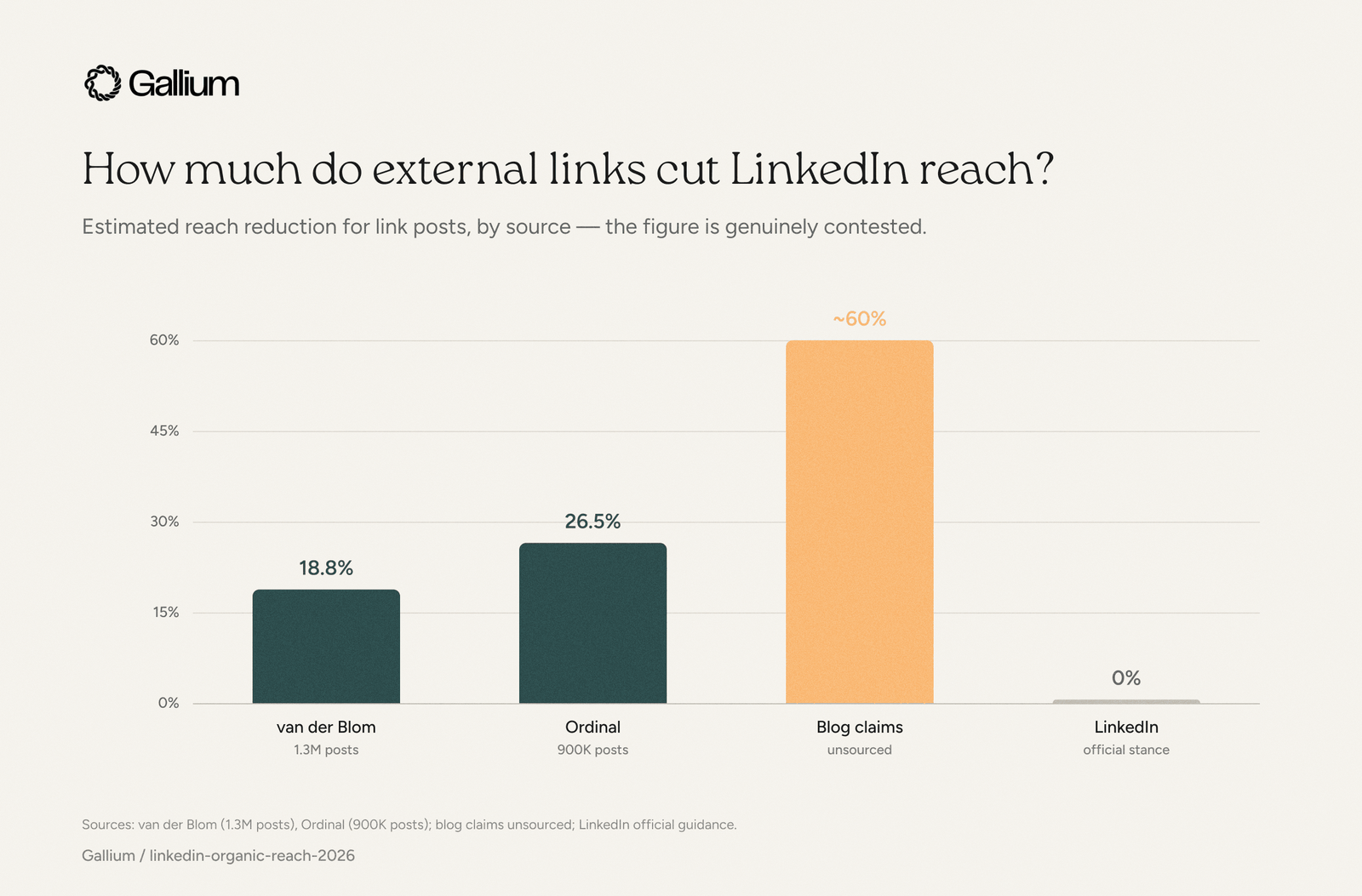
- External links usually cost reach, but the size is genuinely disputed: estimates run from 19% to 60%, and LinkedIn says zero.
- Personal profiles out-travel company pages, which now reach about 2% of followers.
Gallium analyzes thousands of LinkedIn posts for B2B founders, and most of the "rules" circulating about the 2026 algorithm are half-true or recycled. This is the honest version, and the distribution layer behind a founder-led LinkedIn content strategy.
Why organic reach dropped in 2026
Organic reach is the number of people who see your post without paid promotion, and it fell hard this year. AuthoredUp's analysis of 3M+ posts found median reach down about 47% year-over-year, and Richard van der Blom's data landed in the same range.
It is not a glitch. LinkedIn changed what it optimizes for, trading virality and volume for depth and relevance.
The 360Brew model
LinkedIn replaced thousands of separate ranking systems with 360Brew, a single decoder-only transformer of around 150 billion parameters. Same architectural family as the models behind ChatGPT, trained on LinkedIn's own data.
It works in two stages. An LLM-based gate reads your profile and history and decides whether your post even enters the competition. Then a recommender ranks the posts that made it through.
This is why your profile now controls your reach as much as your post does. 360Brew matches a post's topic against your headline, About section, and experience. Aligned content gets distributed; off-topic content gets suppressed. Staying on one topic is how the model decides what you are credible to talk about.
The first 90 minutes
Every post gets a live test before the algorithm commits. When you publish, LinkedIn shows it to a small, engaged segment of your network, then watches. Strong early signals push it out to second- and third-degree connections. Weak signals stop it cold, and most of a post's eventual reach is set right here.
So do not post and disappear. A post that earns ten thoughtful comments and a few saves in its first 90 minutes usually out-travels one with eighty silent likes. Going offline for three hours is the most common way founders kill their own reach.
What the algorithm rewards
Two signals carry most of the weight, and likes are not one of them.
Saves are the strongest signal you can actually influence. AuthoredUp puts one save at about 5x the reach of a like and 2x a comment, which is why LinkedIn added saves to post analytics in late 2025.
Comments matter too, with a caveat: ignore the famous "15x" multiplier. It is unsourced, and quality-aware analysis pegs the real gap closer to 2x. Depth is what wins. Saywhat's read of 100,000+ posts found longer comments performed 302% better.
Delayed engagement counts too. Posts that pick up saves and comments 24 to 72 hours later perform better in suggested feeds, because the model reads sustained attention as lasting value.
What quietly kills reach
Some of the biggest losses come from things founders do without realizing the cost.
External links are the most argued-about penalty on the platform. Most datasets show link posts reaching fewer people, but the size is all over the map: van der Blom's 1.3M-post study put it at 18.8%, Ordinal's at 26.5%, various blogs cite "~60%," and LinkedIn's own product leadership says there is no penalty at all. The honest read: links usually cost reach, the exact tax is unknown, so decide per post whether the click matters more. The old "link in the first comment" trick is no longer reliable either, since LinkedIn now suppresses comments that contain external links.
Engagement pods backfire now. 360Brew spots the same accounts engaging on cue, and creators flagged as part of a pod saw engagement drop 30 to 45% for weeks in one analysis.
Generic, off-topic content also loses the signal that earns distribution. Because the model reads meaning, posts that scatter across unrelated subjects or read like recycled advice fail the expertise check. It is the same dynamic that makes generic founder content stop building pipeline.
Personal profile vs company page
If you want organic reach in 2026, it has to run through a person, not a logo. Company-page organic posts now make up roughly 2% of what shows up in feeds, after a steep decline between 2024 and early 2026. Personal profiles do far better on identical content. The exact multiples come from tool vendors, so treat them as directional, but the direction holds.
So keep the company page for brand, ads, and credibility, and make the founder's profile the distribution engine, with employees as the amplifier.
Turn the mechanics into a loop
Run the same five steps every time you post:
- Open with a line worth finishing. A strong first line helps in the test window.
- Design for saves and comments. Frameworks and a real point of view get bookmarked; platitudes get a like and a scroll.
- Stay on one topic, so 360Brew knows what you are credible on.
- Work the first 90 minutes. Reply fast and let early conversation pull the post wider.
- Keep links out of the body when reach matters.
Do that and reach stops being a weekly guess. It becomes the distribution layer of a founder-led LinkedIn content strategy, and it works best when each post format has a clear job.
Frequently asked questions
Do external links reduce reach?
Usually, but the size is disputed. Studies range from about 19% to 60% lower reach for link posts, and LinkedIn officially says there is no penalty. The "link in the first comment" workaround is now unreliable too. Decide per post whether the click matters more than reach.
Do likes or comments matter more?
Comments, by a lot. Likes are the weakest of the important signals. Saves are stronger still, at roughly 5x the reach impact of a like. Ignore the unsourced "15x comment" claim; the verified gap is smaller, but the hierarchy holds.
Should founders post from a personal profile or a company page?
A personal profile, almost always. Company-page posts reach only about 2% of followers, while personal profiles earn several times the reach on identical content. Keep the company page for brand and ads.
Turn reach into pipeline
You do not need to beat the algorithm. You need a repeatable way to earn attention from the right people and turn it into commercial signal. If you would rather run LinkedIn reach as a system than guess at it every week, book a founder content audit with Gallium and we will map your reach mechanics to a pipeline plan.