


If you've spent a quarter posting on LinkedIn, watched a few likes roll in, and wondered why none of it became pipeline, you're not alone.
LinkedIn should be your #1 GTM channel in 2026 because the B2B buying decision is now mostly made before a sales rep is ever contacted, and LinkedIn is the one place where both decision-maker density and founder-level trust exist at once.
At Gallium we produce and analyze thousands of LinkedIn posts for B2B tech founders every week. The pattern is consistent: LinkedIn is the easiest way to regularly book qualified meetings.
LinkedIn is the only channel that does all three at once.
- Reach the deciders. No other platform concentrates B2B purchasing authority the way LinkedIn does.
- Build trust. Buyers research independently for months; LinkedIn is where they form a preference before they ever fill out a form.
- Move fast. LinkedIn outreach produces accepted connections within days and replies within the first week. SEO pays out in months; cold email needs weeks of domain warm-up.
Everything below is the evidence for that claim, and the honest version of what it does not mean.
The 2026 buyer shift: decisions are happening before sales
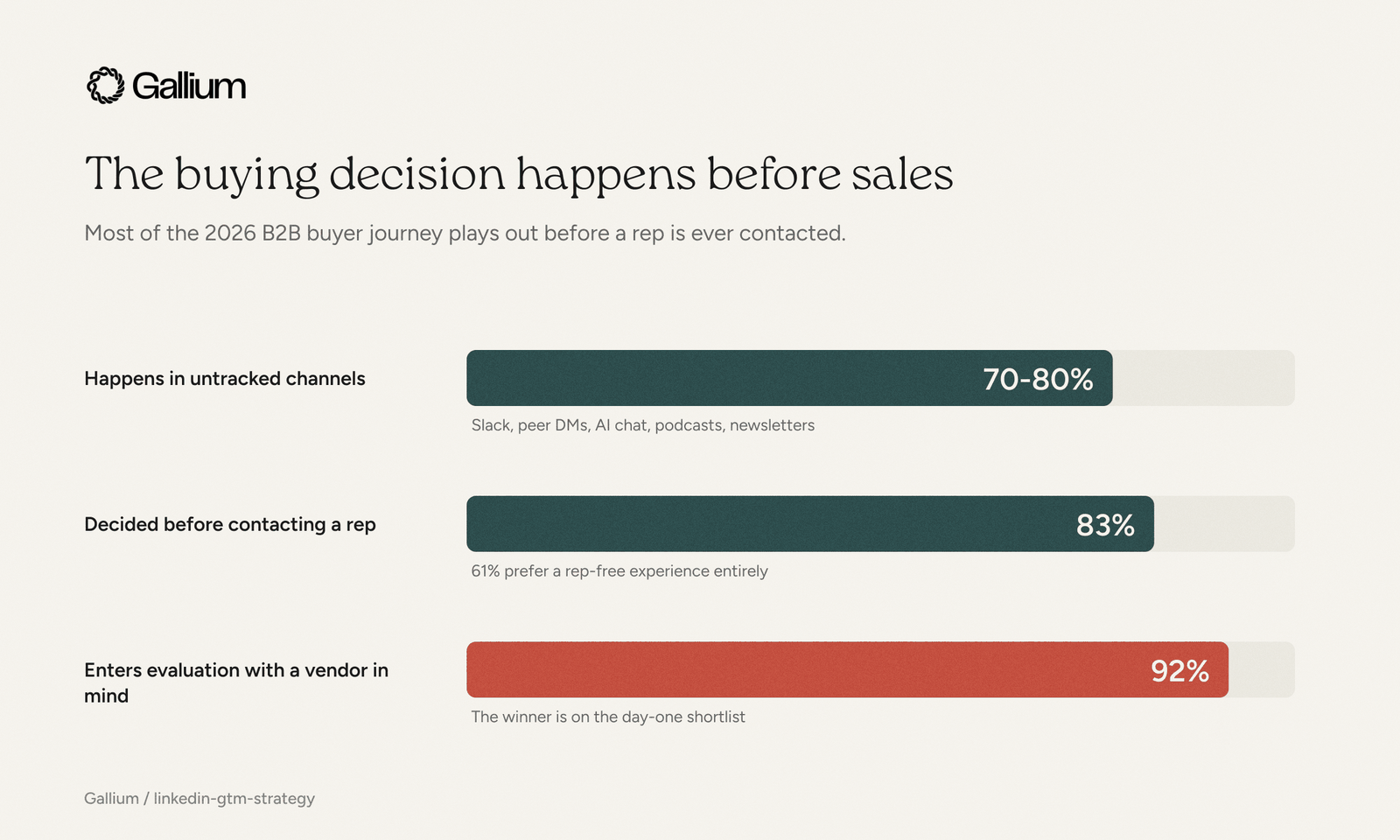
The single biggest change in B2B go-to-market is not a tactic. It is when the decision gets made. AI coding has exponentially increased the amount of products in the market.
That distribution problem gets solved upstream, in public, over weeks. LinkedIn is built for exactly that.
Where your buyers actually are: LinkedIn's decision-maker density
A channel is only as good as the audience it puts in front of you.
LinkedIn crossed 1.3 billion members in early 2026, with roughly 310 million monthly active users. But the raw count isn't the point. The density is. LinkedIn's own audience data describes about 63 million decision-makers, 10 million C-level executives, and roughly 4 in 5 members who influence business decisions at their companies.
The results follow the density. LinkedIn is widely cited as the source of about 80% of all B2B social-media leads, a share that has held for roughly four years, and it drives 46% of all social referral traffic to B2B websites.
No other social platform lets a founder reach a director or VP at a 50-500 person company, filtered by title, seniority, industry, and company size, before writing a single message.
The multichannel architecture: where LinkedIn sits relative to cold email, paid ads, and SEO
Picking a #1 channel is an architecture decision. A working B2B motion in 2026 is multichannel; the real question is which channel sits at the center and feeds the others. LinkedIn earns the center slot for a structural reason: its content is the most reusable raw material in the stack.
A founder post that performs becomes the opener of a cold-email sequence, the creative for a Thought Leader Ad, and the seed of an article optimized for GEO.
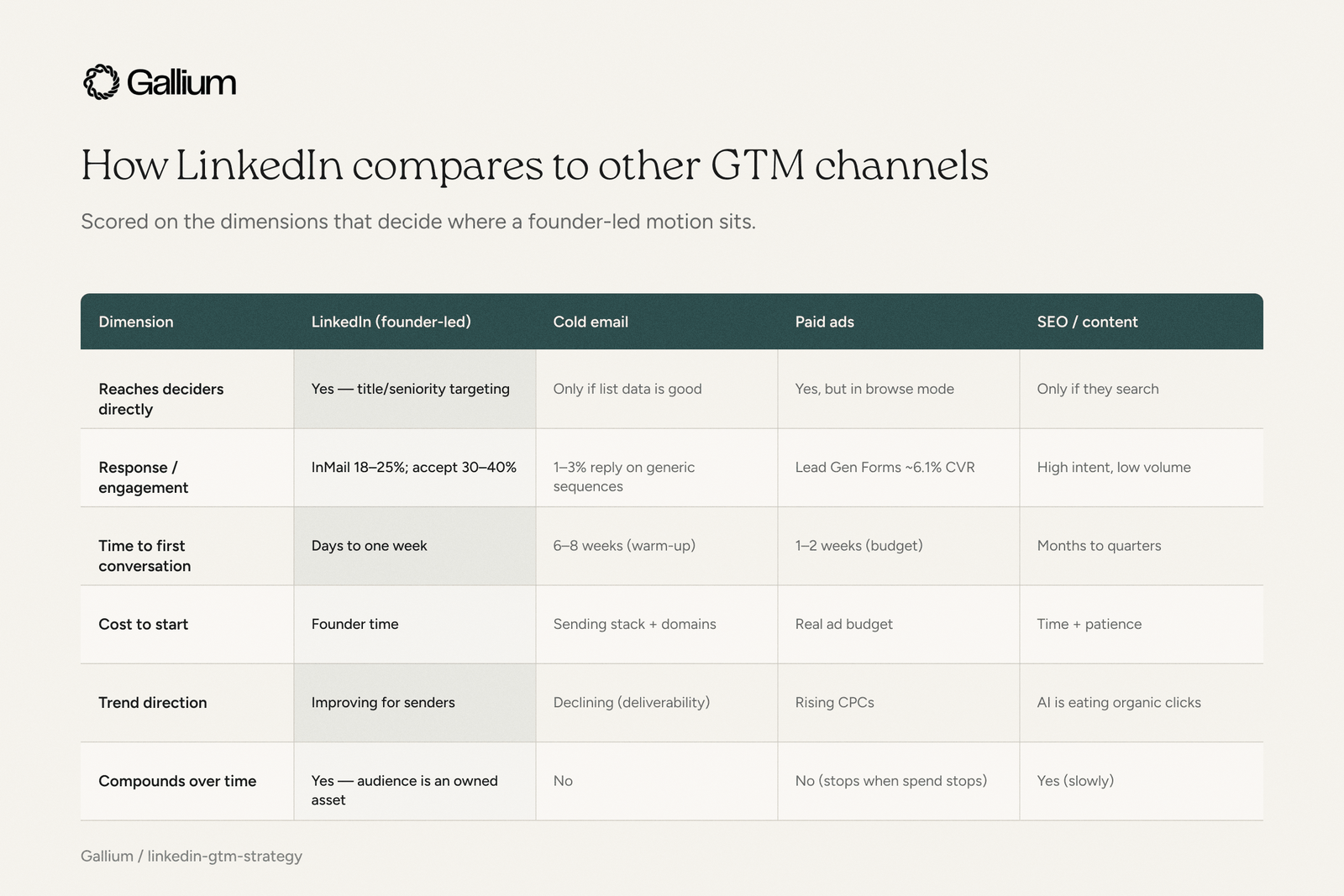
The reverse almost never happens, because a blog post or an ad was never written in a voice a buyer would reply to. Here is how the four channels score on the dimensions that decide the architecture.
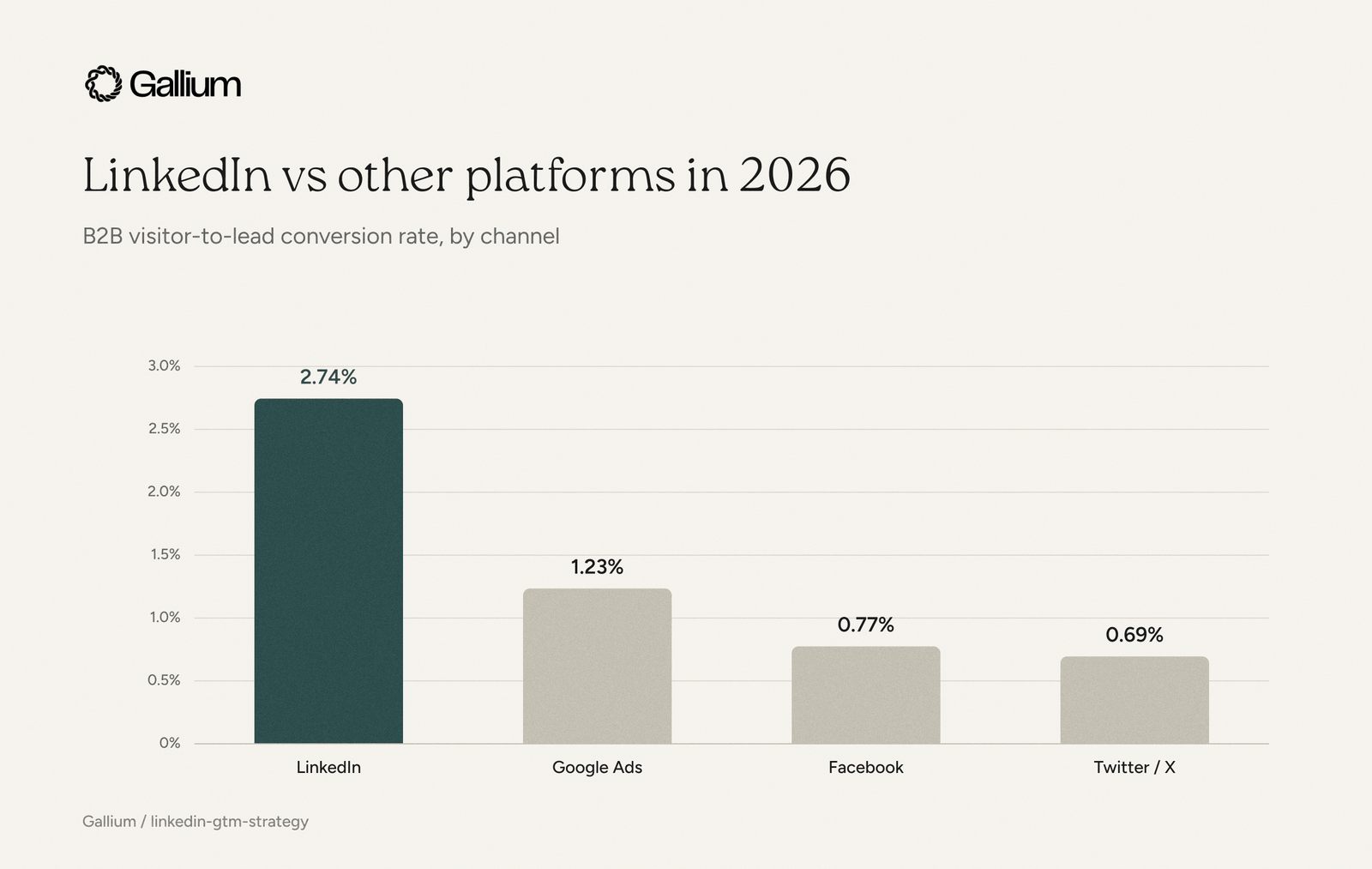
The visitor-to-lead numbers point the same way: LinkedIn's reported B2B conversion rate of 2.74% beats Google Ads (1.23%), Facebook (0.77%), and Twitter/X (0.69%).
LinkedIn loses on exactly one axis — raw scale and cost-per-touch, where cold email still wins. That is why "#1" is a sequencing call, not a monopoly. More on that below.
Why the competing channels are structurally getting worse
The case for LinkedIn is not only that it is good. It is that the obvious alternatives are decaying.
Cold email is hitting a structural ceiling.
- Reply rates: 8-12% (2017-2019) → 1-3% (2025-2026)
- B2B outbound open rates: 35-45% (2022) → 12-18% (early 2026)
- Why it's tightening: DMARC enforcement and AI-spam saturation has made inbox filters more aggressive
- The volume problem: one person with an LLM can now send 50,000 "personalized" emails a week. So everyone does, and the channel defends itself by getting harder
Paid ads punish the wrong assumption. LinkedIn's targeting is excellent, but precise targeting is not the same as purchase intent — only about 10% of your target market is actively buying at any moment. Teams that ask cold audiences to book a demo, then judge the channel on last-click conversions, conclude it "doesn't work."
SEO is slower and increasingly AI-mediated. It still compounds, but it pays out in months, and AI Overviews are absorbing a growing share of informational clicks.
LinkedIn is the channel where the baseline moved in the sender's favor: connection acceptance sits at 30-40% for personalized requests, with 15-25% DM reply rates after connecting.
The compounding advantage only LinkedIn has
Here is the structural reason LinkedIn deserves the #1 slot, and the part most "LinkedIn is big for B2B" pieces miss.
On LinkedIn, outbound and inbound live on the same graph. The content a founder publishes warms the exact audience their outreach is targeting — prospects see the posts in their feed before, during, or after a connection request — and engagement on that content surfaces self-selected warm prospects who can be routed straight into outreach.
No other early channel does both at once. Cold email cannot warm an audience. Paid ads cannot prospect personally. SEO cannot send a DM.
That loop also explains why founder profiles beat company pages. Personal profiles get roughly 2.75x more impressions and 5x more engagement than company pages, and 59% of decision-makers say they prefer content from individual people over brand accounts.
The trust layer matters, too. Decision-makers also read at least an hour of thought leadership weekly and use it to vet vendors before taking a call, with many willing to pay a premium for companies that demonstrate it.
The compounding is the moat. An ad stops the moment you stop paying. A LinkedIn audience is an asset you keep.
What "LinkedIn as your #1 channel" does not mean
This is where most teams break the strategy, so be precise.
Making LinkedIn your #1 channel does not mean:
- Abandoning every other channel. The highest-performing motion is multichannel. Layering email, LinkedIn, and phone produces over 20% higher close rates, 20% lower CAC, and 25% shorter sales cycles than single-channel. LinkedIn is the spine; the others amplify it.
- Posting from the company page. Company-page-only content is the most common failure mode.
- Chasing likes. Engagement is not pipeline. Optimize for ICP impressions, DM conversations, and pipeline influence — not vanity reach.
- Treating it like a search engine. Search captures existing demand; LinkedIn is a browse-mode platform where you create it.
"#1" means LinkedIn is the channel that shapes the preference, and everything else — outbound, retargeting, SEO, events — converts the intent LinkedIn created.
How to make LinkedIn your primary GTM channel: a founder-led operating model
A LinkedIn-first GTM motion runs two engines on one graph.
- The inbound engine (founder content). A founder posts 3-5x per week from their personal profile, built around four kinds of proof: problem proof, market proof, execution proof, and judgment proof. This warms a cold audience over 60-90 days into people who already trust you. For the full content system, see the companion LinkedIn content strategy playbook.
- The outbound engine (targeted outreach). Sequenced, personalized connection requests to a defined ICP, followed by a short, rep-voiced message to those who accept. This produces conversations in week one while the content compounds.
Start both in week one. Outbound seeds the calendar immediately; inbound compounds into warm inbound DMs you didn't have to prospect for. Layer paid (Thought Leader Ads on proven organic winners) only after the organic motion is producing.
How to measure a LinkedIn-first GTM motion
You cannot manage a dark-funnel channel with a last-click model — by definition, you measure the 20% you can see while the channel does its work in the 80% you cannot.
Measure it like this instead:
- Leading signals: ICP impressions, DM conversations started, connection-acceptance rate, post saves from target accounts.
- Self-reported attribution: a "How did you hear about us?" field on every inbound form. This is how dark-funnel channels finally show up in the data.
- Pipeline influence, not last touch: pipeline that included LinkedIn exposure, and sales-cycle length for LinkedIn-warmed deals versus cold.
Frequently Asked Questions
Is LinkedIn really the best GTM channel for B2B?
For most B2B teams selling to businesses with 50+ employees, yes. LinkedIn concentrates roughly 63 million decision-makers, drives about 80% of B2B social leads, and converts visitors to leads at 2.74% — higher than Google Ads, Facebook, or X. It is rarely the only channel, but it is usually the channel the rest of the motion should amplify.
LinkedIn vs cold email: which is better for pipeline in 2026?
They are complements, not substitutes. Cold email wins on scale and cost-per-touch but reply rates have fallen to 1-3% on generic sequences. LinkedIn wins on seniority and engagement quality, with 18-25% InMail response and 30-40% connection acceptance. A hybrid cadence beats either single channel by 2-3x.
Should founders or the company page lead the LinkedIn GTM motion?
Founders. Personal profiles get roughly 5x more engagement than company pages, and 59% of decision-makers prefer content from individuals over brands. Use the company page as a supporting asset — the founder profile is where trust and reach actually compound.
How long does a LinkedIn-first GTM strategy take to produce pipeline?
Outbound produces conversations within days to a week. The content engine takes longer — typically 60-90 days to build a warm audience from scratch. That is why you run both at once: outbound seeds the calendar while inbound compounds.
Does making LinkedIn #1 mean abandoning SEO, ads, and email?
No. It means LinkedIn shapes the buying preference and the other channels convert the intent it creates. Multichannel motions that layer LinkedIn with email and phone show over 20% higher close rates, 20% lower CAC, and 25% shorter sales cycles than single-channel.
Make LinkedIn your #1 channel — start with a 30-day pilot
You do not need a new tech stack. You need a founder voice on the graph where the decision forms.
If you want a faster start, book a 30-minute LinkedIn GTM teardown with Gallium — we'll map your ICP on LinkedIn, audit your founder profile against the trust signals buyers actually inspect, and hand you a 30-day two-engine plan (content + outreach) with the metrics to track. Or read the companion LinkedIn content strategy playbook to build the inbound engine yourself. Either way, a LinkedIn GTM strategy only compounds when a founder runs it as the center of the motion — so start this week.